Blog

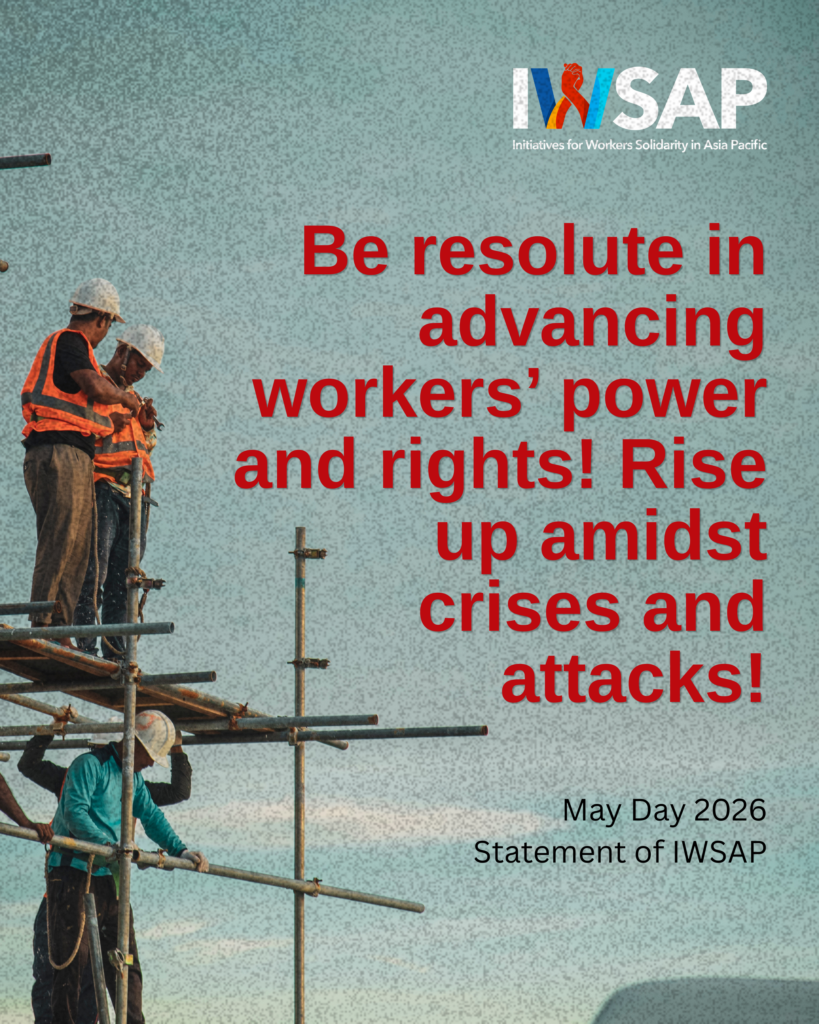
Be resolute in advancing workers’ power and rights! Rise up amidst crises and attacks!

May Day 2026 Statement of IWSAP

The past few months alone have seen an array of socioeconomic crises, impacting various sectors in the Asia Pacific region and around the globe. Politically, the region alone is marred with leaders and big businesses whose only interest is to serve themselves. Meanwhile, all working peoples are shouldering the burden of the lack of political will of states and the uncontrollable wealth extraction of the elites and big corporations from the hands of the exploited. 

In the time of war, especially with the recent US-Israel attacks on Iran, workers are at the receiving end of the impacts of the conflict. Inflation has risen, the value of money has significantly decreased especially in less industrialized countries, consumption taxes have paralyzed workers and their families and of course, prices of basic commodities have gone up to an all time high. While these are all happening at once, big businesses have acquired windfall profits from engaging in oil trading and arms production. On top of this, many labor schemes continue to be unjust, causing labor rights violations and low unionization rate, especially for women and other oppressed sectors of society.

As history taught us however, workers are at the forefront of the fight for justice. They are on picket lines demanding fair wages and safe conditions. They are in parliaments pushing for transformative policies. They are in schools and communities raising awareness and building critical consciousness. Workers are organizing not only among themselves but also in solidarity with other sectors, forging alliances to challenge unjust living and working conditions.

On this International Labor Day, IWSAP stands alongside workers from Asia Pacific and beyond as advocates and rights defenders. Now is the time to deepen solidarity, to create and nurture spaces for mutual learning, and to build stronger networks and alliances among formal and informal workers alike. Collectively, we must hold corporations and states accountable for the centuries of exploitation they have done to those who create the wealth of this world. These will all be done by strengthening the workers movement through arousing, organizing, and mobilizing all workers in the region and the battalion of advocates who stand behind them.

Together, we advance the struggle for workers’ rights. Together, we build a future where dignity, fairness, and justice define the world of work and where exploitation is no longer possible.


Kowloon House workers continue the fight for just wages and management accountability!

Today, April 20, Kowloon House West-Glowhrain KMU workers in Quezon City, Philippines are set to commence another round of negotiation with their management. Despite structural challenges, the workers, their supporters, and the broader ranks of labor advocates hold hand in hand to fight an unequal system that continuously exploit workers.

During IWSAP’s visit to the workers’ strike last week, we talked to Kowloon House West Union President, Bernard Dimaunahan and Kilusang Mayo Uno Chairperson Emeritus, Elmer “Ka Bong” Labog, who shared critical reasons why collective action among workers in and out of the Philippines is very important today. Listen to what they have to say in the reels below! 👂🏼

🗣️ SUPPORT THE STRIKE! WELGA KAMI!

#KowloonWorkersOnStrike#WorkersUnite#AsiaPacific#Philippines

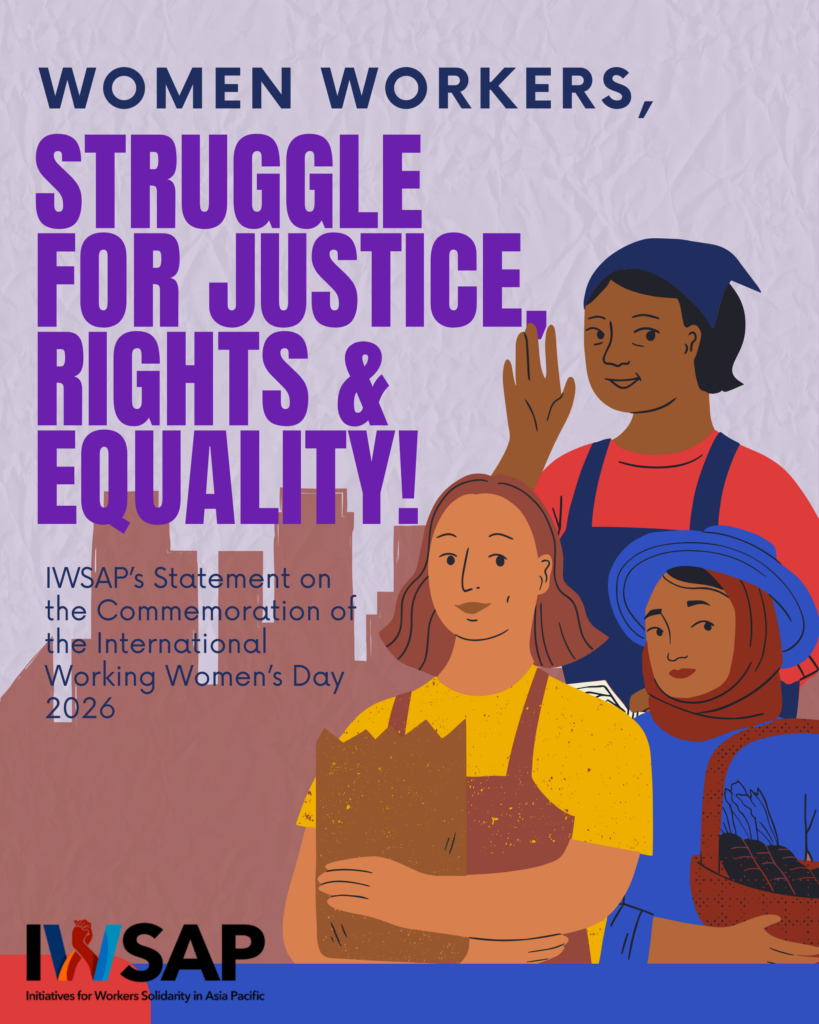
Women Workers, Struggle for Justice, Rights & Equality!

IWSAP’s Statement on the Commemoration of the International Working Women’s Day 2026

The Initiatives for Workers Solidarity in Asia Pacific is one with the working women of the Asia Pacific and of the world in commemorating International Working Women’s Day (IWWD) this March 8. 

Historically, IWWD was borne out of the struggle of women workers in a textile factory in Petrograd, Soviet Union in a massive strike for “Bread and Peace” against the war and food shortages, eventually bringing about the Russian Revolution of 1917. Today, women workers continue to make history as they occupy important seats in households, workplaces, in policy-making, up to the parliaments of the streets.

In contrast to the fighting stance of women everywhere, they also face the worst kind of discrimination, abuse, and economic and sociopolitical inequalities. Working women, especially those in informal and low-skilled work, are severely affected by precarious labor conditions that provide low pay, irregular hours, and limited access to social protections. Given their employment status, these women are also not included in labor policies that should also reinforce their rights to organize and free association. In this context, many women workers who choose to fight back are repressed – jailed or killed – to maintain the status quo unjustly nurtured by states and big businesses. On top of these, women also shoulder the heavy burden of unpaid care work. While they perform back-breaking tasks in the workplace to mitigate the impacts of worsening multiple crises, women are also expected to conform to patriarchal norms and expectations on women. 

Such systemic barriers are tactics of capital and states to contain the ever-growing movement of women workers who are breaking from the chains of their historical oppression in society.

Together with women workers across the region and in the world, IWSAP stands in solidarity with you who partake in the struggle with utmost grit and grace. We will fight together to dismantle systems that do not respect rights, dignity, and justice. Along with the millions of workers in Asia and the Pacific, we shall forge workers’ solidarity in all fronts – for just wages, safer working conditions, the right to organize and to speak up, and a world free of exploitation no matter the class and social status.

A vibrant International Working Women’s Day to all!

#IWWD2026 #WorkersSolidarity

End Wars of Aggression! Workers, Rally for Peace and Solidarity!

Statement of the Initiatives for Workers Solidarity in Asia Pacific (IWSAP) on the recent attack of the U.S. and Israel on Iran

March 4, 2026

The Initiatives for Workers Solidarity in Asia Pacific (IWSAP) strongly condemns the continuing aggression of the U.S.-Israel alliance against Iran and severely impacting other countries in the Middle East. This unprovoked aggression violates the sovereignty and self-determination of nations and the dignity of human life. We call for an immediate and unconditional ceasefire, and an end to all acts of war, especially those prompted by the unending desire to extract and exploit from the oppressed. War only serves the greedy interests of wealthy states and capital – bringing insecurity, poverty, and demise to the working class elsewhere. 

Wars are waged by the powerful, but their costs are borne by millions of workers. Across the Asia Pacific, oil price hikes triggered by such conflicts have led to higher transport fares, soaring food costs, and deepening poverty. At the same time, arms manufacturing has only led to multi-million dollar increases in profits, only benefitting a handful of ultra-wealthy individuals. Meanwhile, workers are being forced to tighten already impossible budgets while corporations continue to profit from crisis and chaos. These hardships expose the truth: wars led by superpowers are not fought for stability and safety, as what they claim, but for more power and more profit. 

For migrant workers in West Asia, the danger is doubled. Many, especially domestic and construction workers, are trapped by border closures or abandoned without pay. Others face expulsion with no guarantee of safety and support. Informal workers, who toil day and night to earn a small income, are forced to pause their livelihood, fearing whether they can still provide food on the table in the coming days.  Their lives, built on sacrifice and labor, are placed at risk by wars they did not and will never consent to. 

IWSAP asserts that it is the time for solidarity and resistance. From offices and factories to farmlands, from migrant communities to union halls and assembly grounds of toilers and workers, we call on all workers in Asia Pacific to rise together. Let us reject wars perpetrated by capital and a handful of powerful states, defend our livelihoods, and claim our collective right to a just and peaceful world built by and for workers and all oppressed peoples. 

Workers Solidarity Now!
End Wars of Aggression!
Long live International Solidarity!


Development Justice for All: IWSAP’s engagement in the preparatory meeting of APRCEM

On February 12, 2026, IWSAP spoke on the preparatory meeting for the upcoming Asia Pacific People’s Forum on Sustainable Development (APPFSD) and the Asia Pacific Forum on Sustainable Development (APFSD). The meeting was organized by the Asia Pacific Regional CSO Engagement Mechanism (APRCEM). The activity focused on the current structural challenges and crises confronting the world now, and the ways civil society organizations and grassroots communities fight inequality using the Development Justice framework.

Clarice Canonizado represented IWSAP in the session, tackling the systemic difficulties being faced by workers today. At the end of her speech, Clarice highlighted the collective actions of workers, trade unions, and workers’ associations in shifting the power.

Read her full speech below.


Good afternoon from Manila, everyone. Thank you for inviting the Initiatives for Workers Solidarity in Asia Pacific to speak in this important activity. IWS-AP is a regional organization working on supporting the struggle of workers in the Asia Pacific and the solidarity-building between formal and informal workers through contributing in campaigns, research, advocacy, and the forging of workers’ associations. 

Workers in the Asia-Pacific region face persistent challenges in securing decent work. Informal work remains the dominant form of employment: approximately 66% of all workers in the region are informally employed, meaning they often lack contracts, social protection, and basic workplace rights. Informal jobs are especially prevalent in agriculture and small enterprises, where standardized wages, paid leaves, and safety protections are minimal or absent. With the rise of the gig economy, many are also informally employed in ride-hailing, delivery services, customer service, virtual assistance and other similar tracks. Under this scheme, many workers are confronted with labor rights abuses, primarily stemming from their lack of recognition as workers.  

The growing use of unregulated algorithmic management in digital platforms poses new and significant risks to workers. Automated systems increasingly determine work allocation, performance ratings, pay levels, and even termination decisions, often without transparency, due process, or accountability – reinforcing labour as a commodity that has no say in conditions governing their work. Workers have little clarity on the ins and outs of gig work and are also exposed to heightened digital surveillance. This exacerbates precarity, undermines collective bargaining, and further weakens workers’ power to assert their rights in an already insecure form of employment.

Women workers are disproportionately affected by precarious labour conditions. Around three in five employed women in the region work in the informal economy, exposing them to lower pay, irregular hours, and limited access to social protections. Women also shoulder a heavy unpaid care burden — on average, they spend far more time on unpaid household and care work than men, constraining their participation in formal labour markets and contributing to persistent pay gaps.

Youth employment remains unstable. Young people (aged 15–24) are far more likely to be informally employed than adults, with around 86% of working youth in informal jobs in many parts of the region. Particularly and with their exposure to digitalization, the youth are often employed in gig work where they often experience having no written contracts or access to benefits, which limits their long-term earning potential and skills development. This cohort also faces high unemployment and underemployment.

Despite overall wage growth in the region, over 90% of low-wage workers are in informal employment, where wage levels tend to be low and volatile. And even in formal employment, corporations and business owners find ways to shortchange workers by denying them of living wages and benefits for faster outputs and higher profits. Amidst these realities, states are complicit in maintaining unequal power and economic structures that hinder mobility of millions of workers in Asia Pacific. 

Labour rights are under attack and civic space is shrinking. Reports indicate widespread violations of basic rights to organise, bargain collectively, and strike across multiple countries, with the region ranking poorly in global rights indices. Weak enforcement of labour laws and neoliberal labour reforms that rollback hard-won labour rights, such as the promotion of contract and platform work, strip workers of their protections, rights and job security.

Amidst this context, multilateralism embodied in the United Nations and other international institutions have constantly failed to address concerns and demands of workers in Asia Pacific. The private sector, big corporations, and wealthier states continue to have a stronger say in the discourses being shaped inside policy spaces. Meanwhile, workers, especially informal and migrant workers, smaller trade unions, and grassroots workers’ organizations are left at the sideline or worse, are not able to participate at all due to lack of financial and logistical support. 

Weak enforcement mechanisms of multilateral institutions also fail to make states and the private sector accountable for their historical negligence in protecting workers. On top of this, financial institutions such as the IMF and the World Bank take advantage of loose accountability mechanisms and the lack of political will to impose neoliberal policies in many countries, affecting economies and the working class each year. The power imbalance between Global North and South countries in the financing space have also resulted in policies that favour the interests of a handful of states and corporations. As a result, wealth becomes more concentrated in the hands of a few.

As it is, multilateralism is unresponsive to the lived realities of workers on the ground. However, with the current UN reforms and geopolitical tensions threatening multilateralism, will global governance become even less effective in protecting workers’ rights and advancing social justice at a time when they are needed most?

On Development Justice

But all hope is not lost because workers, trade unions, and workers associations are doing the bulk of the task to uphold development justice. Workers, both formal and informal, organize and consolidate their strength to address systemic power imbalances. They are involved in mutual aid initiatives and political education efforts to collectively uplift themselves and shift the power away from big businesses, state repression, and other exploiters.  

Across countries, workers have waged strikes and defeated power imbalances in their own ways. They are in the streets, in courts, and in policy-making arenas, continuously asserting their rights and paving the path for social transformation. We have seen this in the general strikes in India (which is having a general strike today against regressive labour law reforms), in factory or firm-wide actions in the Philippines, in the organized actions of gig workers in Thailand and New Zealand, as well as in the small efforts to improve labor education in other parts of Asia Pacific. In platforms like APRCEM, workers and their organizations have been active in promoting alternative solutions that put their issues and demands at the forefront.

This is what development justice looks like – putting workers and all oppressed people at the center of decision-making, discourses on power, and transformative actions. Thank you.


All Workers United Sign-On

From the Global Workers Study Conference held from October 28-30 in Kathmandu, Nepal comes a declaration of commitment to build a new platform for cooperation, the All Workers United. The formation of this new platform for cooperation is in direct response to the all out attacks against workers around the world who suffer from severe conditions of poverty and destitution.

Workers are under attack from all sides by the collusion of capital and governments. Insurmountable debt, soaring prices of housing and social services, excessive taxation, austerity measures, and skyrocketing prices on basic necessities drive down wages and drive up the cost of living to make workers poorer today compared to 15 years back. Unemployment and underemployment are rampant, pushing millions of people into informality and worse precarity, especially for women who carry multiple burdens to also care for their families while bearing brunt of the economic crisis. War and conflict erases jobs, livelihood and futures for our children. 

This is the context in which it is more urgent than ever to build the power of the working people. 

We will form All Workers United in the Global North and the Global South to coordinate the struggles of the workers, organize workers in every community and workplace, and hold capital and governments accountable to the poverty and destitution of workers and toilers.

We will form All Workers United and conduct solidarity at the local, national and global level. We will coordinate with other All Workers United, bring together worker organizations and associations, trade unions, migrant organizations, working women’s organizations, and other organizations of toilers from the Global North and the Global South. We will coordinate across countries and regions through the International Secretariat of the All Workers United.

We pledge our commitment to build All Workers United.

More than ever, the workers must realise the call: “All Workers, Unite!”

If your organization is interested to commit in building All Workers United in your area, sign the sign-on statement here.


List of Organizations who are committed to form All Workers United (AWU):

All Nepal Federation of Trade Unions

Aotearoa Philippines Solidarity

Asia Pacific Mission for Migrants

Asia Pacific Research Network

Association for the Rights of Household and Farm Workers

Bagong Alyansang Makabayan Hong Kong and Macau (BAYAN HKM)

Bayan Aotearoa NZ

BAYAN Asia Pacific

BAYAN USA

Beranda Migran

Bici Libre

BPO Industry Employees Network (BIEN Pilipinas)

Coalition of Agriculture Workers International (CAWI)

Filipino Migrant Workers Union ( FMWU)

Frente unido inmigrantes ecuatorianos

FUNREDES

Gabriela Aotearoa

Gabungan Serikat Buruh Indonesia

General Federation of Nepalese Trade Unions

IBON International

ILPS Seattle

Immigrant Workers Centre

Independent Democracy of Informal Economy Association (IDEA)

Informal Sector Service Centre – Nepal

Initiatives for Workers Solidarity in Asia Pacific

Institute for Motivating Self Employment

Institute for National and Democracy Studies (INDIES)

International League of Peoples’ Struggle

International Migrants Alliance

International Migrants Alliance – US

International Women’s Alliance

KAAGAPAY NG MIGRANTENG PILIPINO SA THAILAND

Kafin Migrant Center (KMC)

Karamay ng Migranteng Pilipino sa Penang

Kasarani Social Justice Center

Kilusan ng Manggagawang Kababaihan

Kilusang Mayo Uno-KMU

Massage Parlor Organizing Project

MFMW

Migrant Thailand

Migrante

Migrante Alberta

Migrante Alberta

Migrante Australia

Migrante Australia

Migrante Canada

Migrante Intl

Migrante Japan

Migrante Melbourne

Migrante Middle East and Africa

Migrante Middle East, Network for Africa Concerns

Migrante NSW – Australia

Migrante Ontario

Migrante Thailand

Migrante sa UWMC

Migrante UK

Migrante United Kingdom

Migrante USA

Migrants Resource Centre Canada

Mitra Wacana

Nexperia Workers Union /  KMU

Pakistan Kissan Mazdoor Tehreek (PKMT)

PCR Argentina

People Over Profit

People’s Artists Initiative

PILAR

PROGRESS

Roots for Equity

Society for Labour and Development

Southern Riders Association

StandUp Movement Lanka

Starbucks Worker’s United

Sulong UBC

Teamsters 117

Ugnayang Pilipino Sa Belgium

Union Network of Migrants

UNITE HERE 11

APALA

United Filipinos In Hong Kong (UNIFIL MIGRANTE-HK)

Vikas Adhayayan Kendra

Vinya Weaving Lab

Workers First Union New Zealand

Victory to the Uber drivers in New Zealand! Forge the solidarity of platform workers in Asia Pacific!

Statement from IWSAP on the recent win of Uber drivers in the New Zealand Supreme Court

We at Initiatives for Workers and Solidarity in Asia Pacific (IWSAP) celebrates and honours the extraordinary courage of Uber drivers and Workers First Union on their landmark victory in the New Zealand Supreme Court. The Supreme Court has affirmed what Uber drivers have been asserting for years – that they are workers who deserve full rights, protection, and respect. This win did not come as easily – it was built on years of resilience, persistence, and collective strength of workers who refused to accept the working conditions Uber imposed on them. 

The court’s ruling exposes the deep injustices of Uber’s contractual model. By misclassifying the Uber drivers as “individual contractors”, they were stripped away their workers’ rights such as minimum wage protection, leave entitlements, and the right to collectively organize – all while maintaining control over their labor. This practice caused immense precarity and hardship, forcing individuals and families into constant instability. Today’s court decision has restored workers’ dignity and acknowledges the bravery of Uber driver claimants – Nureddin Abdurahman, Julian Ang, Bill Rama and Lalogafau Mea’ole Keil. Behind them are other drivers and allies who stood and are continuing to stand against corporate power. 

This victory reverberates far beyond New Zealand. Gig workers throughout the Asia Pacific experience the same structural injustices – the same erasure of rights, the same corporate manipulations, the same neoliberal model that uses platform work to exploit workers and exacerbate precarious working conditions. The win of Uber drivers offers hope to those who continue to push back against unfair systems in the rapidly changing digital economy. Likewise, this is a call and inspiration for workers in different countries to organize and fight back to challenge transnational companies like Uber and dismantle structures which have long been repressing them in all facets of life.

IWSAP stands in unwavering solidarity with gig workers in New Zealand and across Asia-Pacific. The victory of the Uber drivers strengthens our collective resolve to keep pushing until every worker enjoys the dignity and rights that they deserve.

Long live workers of Asia Pacific!

Stand in solidarity with the Indonesian people! Protect workers from state violence! Justice for Affan Kurniawan!

Yesterday, August 29, Indonesian people launched mass actions in Jakarta condemning the outright and long-standing neglect of the Indonesian government on the demands of its people. The protest was a response to a government policy mandating wage increases for parliamentarians amidst unemployment, high inflation, and rising prices and taxes imposed on the people. Reports reveal that 580 members of the parliament receive an additional housing allowance worth USD 3,000 in addition to their hefty salaries. This amount is said to be 10 times the minimum wage in Jakarta and 20 times the monthly minimum wage in poorer locations in Indonesia. On top of this, members of the Congress have been spewing rhetorics that demean the genuine concerns of the people and ignoring their demands for better social and economic conditions.

Amidst the anti-people policies and narratives peddled by the Indonesian government, protests have been going strong in the past couple of months. Police brutality was the government’s response – beating people, and arresting students and workers who just want decent jobs and wages, better social protection, and overall social justice.

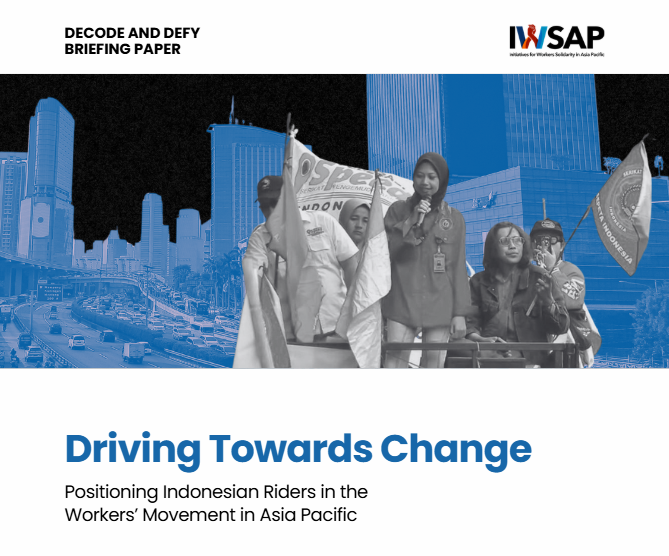
The recent protest which happened yesterday took a more violent turn as a police tactical armored vehicle ran over Affan Kurniawan, a 21-year old motorcycle delivery rider, and killing him. Affan was in the middle of work when the protest took place. He was in no way a participant of the action. 

The Initiatives for Workers’ Solidarity in Asia Pacific (IWSAP) condemns this brutal police act which has been, time and time again, used to silence workers and people’s dissent. More so, IWSAP condemns the Indonesian government’s unjust policy of increasing the wealth of government officials while the majority of the population is reeling in poverty, hunger, lack of jobs, and low wages among others. Workers are the first to be disenfranchised under such conditions as they bear the burden of subpar economic and fiscal policies, and ineffective social services. Just like Affan, young workers are forced to take on multiple informal jobs to help their families survive and fund their education. 

What happened to Affan and what is happening in Indonesia is an eye-opener to the struggles of young, informal workers, and the people of Indonesia and the region.

Working people in Asia Pacific are faced with the same reality of state neglect and violence on top of economic difficulties that result from anti-people and neoliberal policies. In this context, workers must band together to further strengthen their assertion for justice, rights, and welfare. In the same vein, IWSAP stands in solidarity with the people of Indonesia and their struggle for jobs, decent wages, rights, welfare, and against corruption. 

Let us demand justice for Affan and for all workers who continue to fight exploitation, oppression, and violence from the state and its forces.

#JusticeForAffanKurniawan #JusticeForIndonesianPeople #WorkersUnite

Raise the struggle of platform workers! IWSAP welcomes the decision of the ILO to work towards a binding agreement on decent work in the platform economy

The Initiatives for Workers’ Solidarity in Asia Pacific (IWSAP) welcomes the agreement made at the recently concluded 113th Session of the International Labor Conference (ILC) to negotiate and work towards a binding convention on decent work in the platform economy in 2026 (See: proposed resolutions and conclusions from the ILC). This comes at a crucial time where platform work is becoming more in demand and precarities experienced by workers become more acute.

The IWSAP welcomes the positive decision because it is more urgent than ever to protect the rights of all platform workers in the face of intensifying exploitation. As reflected in the outcomes of IWSAP’s Workers Study Conference in 2024, platform work continues to grow and diversify, leading to high profit for companies. In Thailand, Cambodia, and Indonesia, motorcycle taxis and delivery riders have become a part of urban life. Despite the promise of flexibility, platform workers are forced to work overtime to reach quotas. Yet, they receive measly income, and do not receive social protection as they are not covered in labor laws. With their exclusion in labor laws, they are also not allowed to form workers’ organizations or become members in unions. This puts them in more precarious working conditions while the apps they work for continue to reap exponential earnings from the labor of others. Similarly, this is the case for Uber drivers in New Zealand who are considered as “freelance partners” – a loophole being taken advantage of by Uber to bypass their responsibilities in giving proper and standardized remuneration to drivers.

With this reality, IWSAP welcomes the effort of the ILO to formally proceed with the pursuit of crafting the binding convention next year, especially along the lines of several crucial points in the resolution made:

  • Respect for freedom of association
  • Recognition of employee and employer relationship between platform workers and the companies and apps they work for
  • Meaningful participation of platform workers in policy spaces and collective bargaining
  • Appropriate and livable remuneration that is “at least equivalent to the statutory or negotiated minimum wage”
  • Social protection for platform workers who have long been sidelined by institutionalized protection because they are recognized as formal workers
  • Occupational safety and health (OSH) protection 
  • Standardized and humane working hours and rest days
  • Inclusion of migrant and refugee platform workers in policies and policy-making
  • Access to dispute mechanisms and remedies     

We expect that in the process of negotiations, big corporations and digital platforms will double their efforts to dilute the crucial points in the convention and make it advantageous for them. The workers must be vigilant and ensure that we build our ranks to promote workers rights and prevent any diminution of these rights. We call on the ILO and member states to be accountable in ensuring that the demands of platform workers will be heard during the negotiations, guaranteeing meaningful participation in all levels of decision making. 

As IWSAP, we join all forces of workers and formations of platform workers in clamoring for change in the world of work. While the resolution on platform work is an initial success, we do not stop here. This is just the initial step in demanding fairness and dignity to those sidelined by policy and profit. Now more than ever, platform workers and other informal workers, formal workers, workers’ associations, unions, and other civil society organizations must join hand in hand in strengthening our ranks to ensure that the process of negotiation for the convention will mirror the long overdue calls of platform workers for equal and just treatment in their areas of work.

A Show of Force: The success of the launch of IWSAP’s Workers’ Study Conference Results and its formation

Our modernizing world has exposed to us the acute exploitation that workers have to face just to be able to make ends meet. Informal and formal workers alike in the Asia Pacific region alone are at the forefront of shouldering multiple personal and systemic burdens. It is in this context that the Initiatives for Workers Solidarity in Asia Pacific (IWSAP) presents itself as an avenue which will bridge the gaps between informal and formal workers who must organize themselves to overcome structural barriers to achieve decent work, living wages, social protection and many more.

As a start in upholding the mandate of IWSAP, the organization launched the formation and the results of its first Workers’ Study Conference (WSC) last 30 May 2025 in Bangkok, Thailand and online. The event gathered 23 in-person participants from Kaagapay ng Migranteng Pilipino sa Thailand (KMPT), Workers Union of Thailand, Southern Riders Association, HOMENET, Migrant Domestic Workers Network of Thailand, representatives from the International Labor Organization (ILO), as well as some Myanmese and Thai university students. At the same time, 57 participants joined online hailing from Australia, Japan, New Zealand, Sri Lanka, Bangladesh, Hong Kong, South Korea, the Philippines, Indonesia, Cambodia, Thailand, Middle East, and Nepal. Big trade unions such as UnionAid and the International Transport Workers’ Federation (ITF) from New Zealand were also present, as well as representatives from UN WOMEN. 

Grounded in Reality

Bungon Tamasorn, IWSAP’s board chairperson, welcomed the participants in a video recorded message, impressing the importance of organising and working with informal workers, and their unity with formal workers in their fight for rights, wellbeing and dignity. Following this, a short video was presented to the participants, introducing IWSAP and some salient points from the WSC Results. 

Lei Covero, the Southeast Asia Coordinator of the Asia Pacific Mission for Migrants (APMM) presented the results of the first WSC. The first WSC was held on November 23-24, 2024 in Bangkok, Thailand as well. The results highlighted the realities on the ground of informal workers, specifically those who do gig and platform work, domestic migrant work, and agricultural work among others. Issues of women in informal work were also discussed, emphasizing the gender biases they experience in the workplace and the double burden of earning an income while taking care of the family. The WSC Results revealed the continuing precarious conditions of informal workers in the region ranging from lack of decent work and social protection, discrimination, non-inclusion in labor policies, and slave-like conditions in workplaces among others. 

But despite the seemingly bleak situation of many informal workers, there are efforts to counter the current structures that oppress both them and even formal workers today. Research initiatives and campaign-building are just two of the main works of different workers’ organizations and associations that contribute to strengthening their ranks. Lei ended her presentation with an inspirational quote urging the participants to take on the cause of building strength and solidarity with informal and formal workers – “If we don’t struggle, who will? If we don’t struggle now, then when?”

Voices for change

As a sign of support from some participants, video and in-person messages were shared by Workers First Union, Southern Riders’ Association, Coalition of Agricultural Workers International (CAWI), the Asian Migrants Coordinating Body (AMCB), the Kaagapay ng Migranteng Pilipino sa Thailand (KMPT), and the Asia Pacific Mission for Migrants (APMM). The organizations expressed their support to the IWSAP and vowed to continue the fight for workers’ rights and dignity, and further solidify the unity of informal and formal workers in Asia Pacific. 

The IWSAP also presented the Bangkok Commitment, a declaration of commitment to support the formation of IWSAP, its initiatives, and the collective work of building unity and solidarity among informal and formal workers in the region. The Bangkok Commitment has garnered 18 endorsements as of writing – a reflection of the urgency to come together for the rights and dignity of workers. 

Paving our path as one

To galvanize the IWSAP’s next steps, Elna Abila of KMPT presented concrete points of actions that the organization will take on in the future. She shared the plans on conducting research projects, capacity-building of partners and workers, and bolstering support to workers’ campaigns. 

With the conclusion of the launch, IWSAP is positive of what needs to be done and reaffirms its role in bridging the struggles of informal and workers in Asia Pacific. From hereon, the IWSAP is excited to propel more activities and events, contribute to broadening understanding on workers’ issues, and prop up initiatives and demands of workers in the region. 

See photos from the launch below!